Maya is really hard
 I'm
taking a class in animation using
Maya 5.0. Here you can look at how much I'm an engineer and not an artist.
I can use Matlab (which sucks, can't miss an opportunity to point that out),
Mathematica, AutoCAD, and PSpice, and I can program in C, assembly, and perl
under unix. All of those things are way easier than Maya.
I'm
taking a class in animation using
Maya 5.0. Here you can look at how much I'm an engineer and not an artist.
I can use Matlab (which sucks, can't miss an opportunity to point that out),
Mathematica, AutoCAD, and PSpice, and I can program in C, assembly, and perl
under unix. All of those things are way easier than Maya.
This page is broken up so that people with modems will not have to
wait all year for it to download. I want to be the last person in the world
with one of those slick procedural browser pages.
Assignment 1
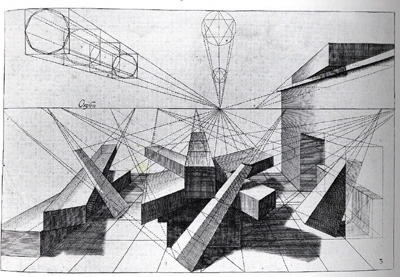
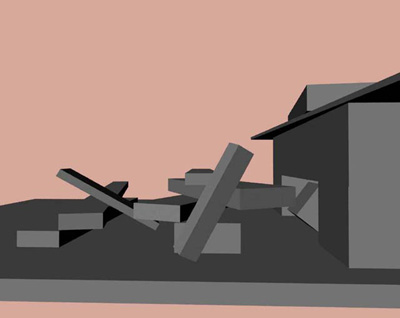
Here I had to do a render based on the DeVries pic at left. The object
is learning how to create, scale, translate, and rotate NURBS objects using
the GUI. Whee.
Assignment 2
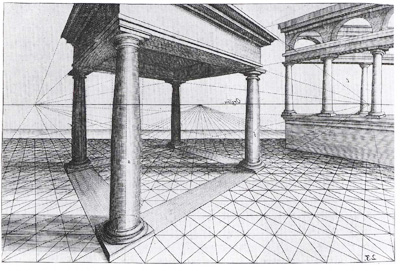
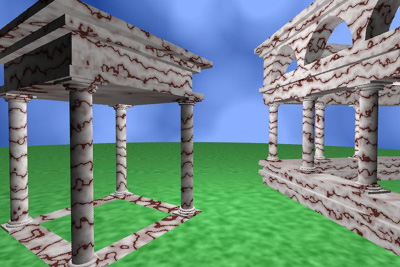
Another DeVries pic. The object here is using revolve, project, trim,
and loft to create more complicated NURBS shapes. I added textures and colors
on my own, and probably incorrectly.
Assignment 3

Introduction to lighting. This scene attempts to describe a sunset using
an orange point light source, which is located well outside the scene, and
a blue ambient source, located just above and to the left. The NURBS arches
are showing off how polygonal they look in the shadow at left. I still can't
figure that one out, and I haven't been able to replicate it. Oh well.
I eventually figured out why my NURBS were looking all polygonal;
messing with the tessellation controls fixed it. Maya guesses at the
resolution to use based on camera distance, but if you project the problem
close to the camera it's not quite smart enough to catch it.
Messing around: dice
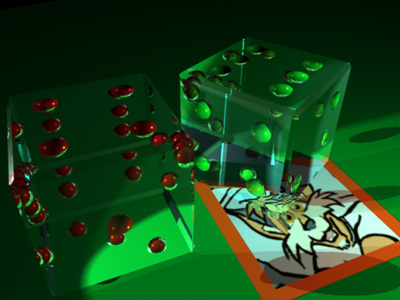
Not an assigned project. I wanted to see if I could make a refractive
object, and I figured that out, so I tried to make a set of dice. They are
supposed to look like the "dots" are painted dimples in the glass. I got
that to work, but if you look carefully, you can see that the dots are not
depressed into the glass surface. I'm not sure how to fix that yet.
The cubes are polygons, but the dots are nurbs. That could be part of the
problem. The "photograph" is obviously a textured polygon.
Messing around: soap bubbles
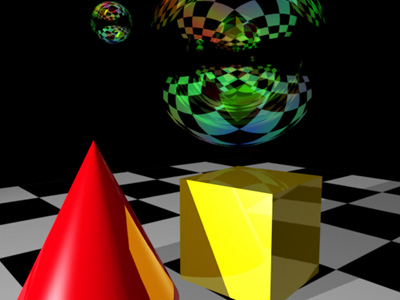
I needed to make a mirror for the next class project, so I spent a few
hours trying to figure out how reflections work. I discovered what I was
doing wrong only after I stumbled on a really cool way to make a soap bubble.
I will endeavor to prepare a tutorial on it later, but if I can figure
it out, you probably can, too. The material is a tartan ramp with some
low-frequency noise, mapped to the specular color channel of a blinn shader,
which has been made otherwise black and transparent. It took me a while
to figure out why the bubbles and background were missing entirely
from the picture. Welcome to alpha channels.
Next page:
Assignment 4: The Music Lesson
This document, and all other documents, images, and other
files contained within this site are copyrights of their
respective owners. No file may be duplicated without explicit
written permission of the author unless permission is otherwise
noted here.