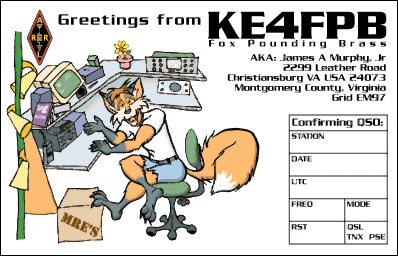
I've been a ham since 1993. I am now an extra and a volunteer examiner. I enjoy QRP, homebrewing, and nursing old radio gear back to health. Email me for a sked to get the fabulous QSL pictured above.
I use an Alinco DX-70T, both mobile and at home. On the road I use a 20m Lakeview HamStick(tm), which works incredibly well. Even after I tried to ruin it by dragging it behind my truck at 70MPH (The Radioshack 3/8 magnet mount is not my favorite anymore), it is the coolest antenna I have. I'd recommend it to anyone; it works the whole band and pulls in the contacts with minimal power.
I used to have a 132' coax-fed wire dipole hanging in the trees behind my house. It's the same antenna you will find in the ARRL's Antenna book or handbook, with the hasty coax choke balun. Sadly, the feedpoint came undone after a few winters and I haven't been able to find the time and assistance to get it back up there. I haven't made any dummy-load contacts yet.
By necessity, my favorite bands are 20m and 80m (see the antenna bit above). I also will shoehorn my dipole into other bands with a tuner but I have not had a great deal of luck there. Occasionally I will fling a random wire into a tree and make a few contacts on whatever band I can get.
When I'm on HF, I can be found in the novice CW segment of the 80m band (3675kHz-3725kHz). I will also lurk around on the QRP portion of 40m (7025kHz-7030kHz), but as the DX-70 is not technically a QRP rig, I don't do a lot of transmitting there. If you're on 20m QRP, give my dad (KB2JWD) a call; you've got a good chance of catching him.
Most of the time, though, I'm on 2 meters. Here's a list of the local repeaters (the ones that are frequently monitored, anyway) for my area, Roanoke, Christiansburg, Blacksburg, Radford, Pulaski, Dublin, etc:
I send my QSL cards as postcards for two reasons. It's cheaper, and I think it's nicer to have one that's been handled by the post office. Occasionally, however, the postal crew does get a little rough with our mail, so if you receive a mangled QSL from me, just send a SASE and I'll send a replacement card.
If you are considering becoming a ham radio operator, good for you! It's a fun hobby and a way for you to provide vital communications services to your locality during emergencies or public gatherings. You don't have to start with thousands of dollars of gear; you can find free equipment and loaners everywhere.
You will start by learning the material for the exam. A knowledge of electronics and radio theory is obviously helpful, but not necessary for you to get your license. You don't need a degree in engineering to be a ham, or to understand the equipment. If you can operate a cellphone, you can do it. Also, you don't need to learn Morse code. The technician class license allows you to work everything from 50 MHz up, and doesn't require a code exam. You can learn the code later and upgrade your license.
When you're ready, you will go to an exam session, and take a multiple-choice test that will last about an hour. It will cost you about ten dollars for the testing materials and processing fees. After an agonizingly long period of several weeks, you will receive your "ticket" in the mail and are ready to go on the air. You should consider joining a club to stay on top of events in your area. However, your license will not obligate you in any way. You are free to choose how you will support your community as a ham.
The best way to get "in" is to find a local club. If the yellow pages don't pan out anything, try calling around. Most fire and rescue departments, police, or Red Cross personnel work and train with amateurs. Somebody should be able to point you in the right direction. You might also try calling a local college to find out if there's a campus ham radio club. If you can receive the 2 meter band with a scanner or ham receiver, listen from 144-148 MHz for local repeaters and you might get a phone number or address for the club in your area.
Check the local papers, too. Amateur licensing exams are always advertised in the classifieds. The fourth weekend in June is Amateur Field Day, a big outdoor party where hams try to make as many contacts as possible. This event is almost always advertised well in advance.
If that doesn't work, introduce yourself to the next ham you happen to see (they can be identified by their license plates.) He or she will be happy to talk and put you in touch with the right people. If you're extremely unlucky you might catch somebody in a bad mood. Forget about it. Remember that amateur operators are public service personnel first. Chatting on repeaters and hanging out at McDonald's are secondary to helping you, especially now that you're interested in joining us. Of course, you can email me with any questions about ham radio. 73!
^[:wq
This document, and all other documents, images, and other files contained within this site are copyrights of their respective owners. No file may be duplicated without explicit written permission of the author unless permission is otherwise noted here.